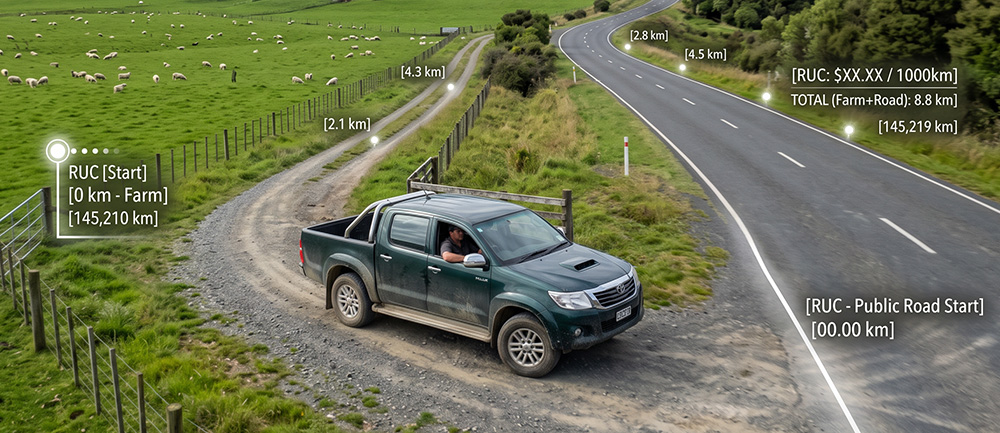
If you run diesel, you already pay road user charges. You buy distance before you travel it, in blocks of 1,000km, and the rate depends on what the vehicle weighs. Plenty of Fuel To Go customers have been paying them for years without giving it much thought. What's worth knowing is what it costs, what you can claim back for time spent off the road, and what's about to change. Here's where it sits as at September 2026.
Diesel and heavy vehicles pay road user charges, or RUC, and so do light electric vehicles and plug-in hybrids. Petrol vehicles don't, because petrol carries fuel excise duty at the pump instead. Diesel doesn't carry that excise, so the charge is collected on distance.
The mechanics are straightforward. You pre-pay for distance in units of 1,000km, and you buy more before you've used up what's on your current licence. You can buy up to 6 licences at a time online. Light vehicle licences, up to 3500kg, don't expire. Heavy vehicle licences expire one month after any rate rise, and at that point you buy an overlap licence starting from your current hubodometer reading.
Where the licence goes depends on the vehicle. Light vehicles display it inside the windscreen, passenger side. Heavy vehicles and trailers can display it or carry it, as long as you can show it to an enforcement officer.
Rates are set by NZTA, quoted per 1,000km and including GST. A light diesel vehicle up to 3500kg, which covers most farm utes, pays $76. From 3501kg to 6000kg it's $82. From 6001kg to 9000kg it's $167. A 2-axle vehicle over 9000kg pays $352. Multi-axle trucks and combinations have their own rates and weight bands.
On top of the rate there's an administration fee on every licence you buy. It's $12.44 online or in the NZTA app, and $13.71 over a counter at an agent. That fee is per licence, not per 1,000km, which is the argument for buying in larger blocks.
If you drive past the end distance on your licence, NZTA will invoice you for it. The odometer reading taken at your warrant of fitness is usually how they find out.
Yes, for distance travelled off-road, and it's the part that's easiest to overlook. If you've run a vehicle off the public road, you can apply for a refund on that distance.
The conditions are worth knowing before you start. The claim has to be for $20 or more. You apply within 2 years of the licence issue date. You need to have either used all the distance on the licence, or sold or deregistered the vehicle (NZTA's wording on this is loose, so check before you apply). You keep records of where, when and how far, and NZTA can ask to see them for 2 years. Allow at least 10 working days to process, longer if you post it.
On a farm with a few utes doing paddock work, that distance adds up faster than you'd think.
There's a separate refund if you replace a hubodometer before you've used all the distance on your licence. The application fee for that one is $8.77.
A lot of farm and forestry gear doesn't pay road user charges at all, because it isn't built for the road. Tractors are exempt. So are combine harvesters, pea viners, windrowers, silage choppers, hay balers, cultivation equipment and silage wagons. On the forestry side, log forwarders, log processors, post debarkers and all-terrain vehicles are exempt, and so are front-end loaders, excavators and bulldozers.
Two catch people out. A fertiliser spreader isn't exempt if you use it to move fertiliser by road, and neither is a weed sprayer built on a truck chassis.
There's also a permanent exemption for a light diesel vehicle that's almost always used off-road, for farming, forestry or one of 6 other listed uses. Four conditions hold it in place; you own the vehicle, you drive off-road at least 90 percent of the time, on public roads you stay within 10km of the boundary of the property where the vehicle is kept, and the exemption sticker stays on the windscreen at all times. If any of that changes, the exemption stops and you'll need to apply again or buy a licence.
eRUC is the electronic version of the same thing. It automates the buying, records distance more accurately than reading an odometer, and keeps the off-road records that support a refund claim. That last point matters if you're doing paddock work and not currently claiming it.
It isn't new or niche. When the Transport Minister announced the reform programme in August 2025, he said electronic RUC companies already handled "about half of our heavy vehicle fleet".
The government is reforming how road user charges are bought and paid for, ahead of eventually moving petrol vehicles onto the same system. NZTA has published what the law changes are meant to cover:
The Minister has described the current system as "largely paper based" and said it "requires people to buy RUC in 1000 km chunks". Both of those describe what diesel operators deal with now, so the changes land on you before they land on anyone driving petrol.
On timing, be careful with what you read. NZTA's current position is that no date has been set for when all light vehicles start paying road user charges. The Minister expects to pass the legislation in 2026. In November 2025 he said the government would assess the improved system in 2027, then decide on next steps for the remaining 3.5 million vehicles. Dates in this area have moved before and may move again.
If you run petrol vehicles as well, the change reaches them eventually. No date and no rate have been set, and there's nothing to buy or set up yet. NZ Fuel Cards has covered the petrol side in a separate post.
How much are road user charges for a diesel vehicle?
For a light diesel vehicle up to 3500kg, $76 per 1,000km including GST. Heavier vehicles pay more, based on weight and axle configuration. An administration fee of $12.44 online, or $13.71 at a counter, applies to each licence you buy.
Do road user charges expire?
Light vehicle licences, up to 3500kg, don't expire. Heavy vehicle licences expire one month after a rate rise, and you buy an overlap licence at that point.
Do road user charges include GST?
Yes. The published rates and the administration fees are all GST inclusive.
Can I get a refund for driving off-road?
Yes, for distance travelled off the public road. The claim has to be $20 or more, and you apply within 2 years of the licence issue date. You'll need records of the off-road distance.
Road user charges are paid to NZTA or an approved provider, so a fuel card doesn't cover them. What we cover is the fuel side, on one invoice. If you'd like to talk that through for your vehicles, give the Fuel To Go team a call on 0800 383 586.